What Is IEP Progress Monitoring?
IEP progress monitoring is the ongoing collection of student performance data tied directly to an IEP goal. Its purpose is to determine whether a student is making progress toward the goal and whether instruction or interventions need to change.
Good progress monitoring uses consistent measurement methods, produces clear data points, and allows teams to see trends well before an IEP meeting. When done well, it helps teachers adjust instruction early and helps schools explain student progress clearly to families
What Good IEP Progress Monitoring Looks Like
Good IEP progress monitoring is simple, consistent, and easy to explain.
In classrooms where progress monitoring works well, teams collect data on a regular schedule using the same measurement method each time. Scores are recorded as individual data points, not summaries entered weeks later.
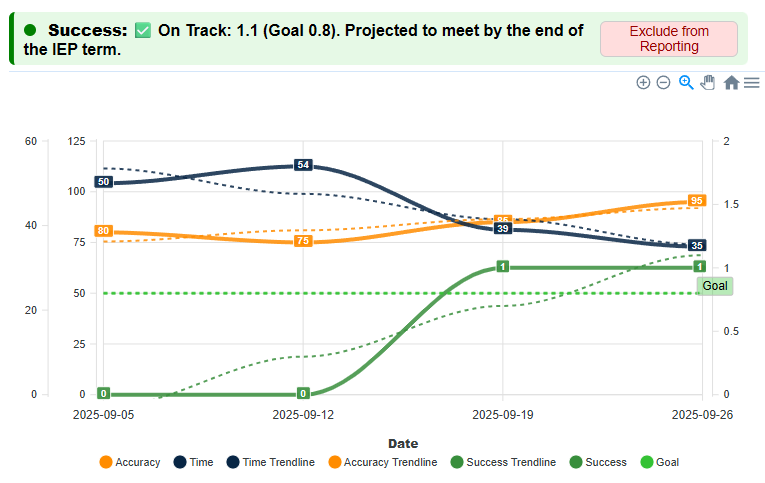
Strong progress monitoring also produces graphs that update automatically. Teachers can see whether a student is improving, plateauing, or falling behind without having to recreate charts by hand.
Most importantly, good progress monitoring allows teams to notice trends early. When data shows that a student is not responding to instruction, changes can be made before an IEP meeting instead of after.
Common IEP Progress Monitoring Mistakes
Many IEP progress monitoring problems are not caused by a lack of effort. They happen because systems are inconsistent.
Common issues include collecting data irregularly, changing measurement methods mid-year, or entering multiple data points all at once before an IEP meeting. In these situations, graphs may exist, but they do not reflect what actually happened instructionally.
Another frequent problem is data living with individual teachers instead of following the student. When staff changes occur, historical data is often lost or cannot be compared across years.
These patterns make it difficult for teams to explain progress clearly and increase the risk of compliance concerns.
Real Classroom Examples of IEP Progress Monitoring
Consider a reading fluency goal where a student is expected to increase words read correctly per minute.
In a strong progress monitoring setup, the teacher collects one data point each week using the same passage type and scoring rules. Each score is entered immediately, and the graph updates automatically. Over time, the trend line shows whether the student is closing the gap toward the goal.
If the data shows progress slowing or flattening, the team can adjust instruction right away. By the time an IEP meeting occurs, everyone can clearly see what happened and what decisions were made.
In contrast, weak progress monitoring might involve collecting scores sporadically, entering multiple data points at once, or recreating graphs just before meetings. In those cases, teams are reviewing history instead of using data to guide instruction.
These IEP progress monitoring examples highlight how consistency and timing matter more than complex tools. These IEP progress monitoring examples show how consistent data collection and clear graphing support better instructional decisions.
Why IEP Progress Monitoring Matters for Compliance
IEP progress monitoring is not just a best practice. It is a compliance expectation.
Schools are expected to monitor progress toward IEP goals and report that progress clearly to families. When data is inconsistent or unclear, it becomes difficult to demonstrate that appropriate instruction and adjustments occurred.
Strong progress monitoring helps schools show that decisions were data-based and timely. It reduces last-minute scrambling before meetings and makes documentation easier to explain.
Just as important, it protects teachers and administrators by creating a clear record of instructional response over time.
A Simple Self-Check for Schools
Schools can use the following questions to evaluate their current progress monitoring practices:
- Are data points collected on a regular schedule?
- Is the same measurement method used throughout the year?
- Do graphs update automatically as data is entered?
- Can administrators review progress without asking teachers to rebuild charts?
- Does student data follow the student when staff changes occur?
If several of these questions are difficult to answer, it may be time to revisit how progress monitoring is structured.
Bringing It All Together
Good IEP progress monitoring does not require more work. It requires better systems.
When data is collected consistently, graphed automatically, and tied directly to student goals, teams can focus on instruction instead of paperwork. Decisions happen earlier, meetings are clearer, and progress is easier to explain. These IEP progress monitoring examples show how consistent data collection and clear graphing support better instructional decisions.
This is the standard schools should expect for IEP progress monitoring, and it is achievable with the right approach.
Why Schools Are Rethinking IEP Progress Monitoring
Many schools are realizing that progress monitoring is not just a compliance task. It is one of the most effective ways to improve instruction and student outcomes. Schools often ask how frequently progress monitoring should occur during the school year.
When progress monitoring is consistent and visible, teams can respond sooner, communicate more clearly with families, and make data-based decisions with confidence.
Strong IEP progress monitoring systems help schools move from reacting at meetings to adjusting instruction throughout the year.
Final Thoughts on IEP Progress Monitoring
Good IEP progress monitoring is not about collecting more data. It is about collecting the right data, in a consistent way, and using it to guide instruction.
When schools build systems that support regular data collection and automatic graphing, teachers spend less time managing paperwork and more time teaching. Administrators gain clearer insight into student progress, and teams are better prepared for meaningful IEP discussions.
The goal of progress monitoring is simple: to ensure that decisions are made early, transparently, and in the best interest of the student.