
What the Percentage or Score Means in Practice
Many occupational therapy goals use percentages like 80% accuracy.
How Schools Should Measure Progress on Occupational Therapy IEP Goals
Occupational therapy IEP goals often focus on skills like handwriting, written expression, and fine motor control. These goals may look clear when they are written in the IEP.
But measuring progress on occupational therapy IEP goals is often harder than it seems in real classrooms.
Teachers and therapists are asked to report progress at IEP meetings, but the real question is always the same:
How do we know the student is actually improving?
If the goal involves handwriting, writing endurance, or written expression, progress must be tracked in a way that is objective, repeatable, and defensible.
When progress monitoring is done correctly, teams can see improvement early. When it is vague, schools often discover problems too late.
This is especially true for occupational therapy handwriting goals, where small improvements in motor skills may happen slowly across many weeks.
Below is how schools should measure progress so that the data actually tells a clear story.
What Occupational Therapy IEP Goals Measure
Occupational therapy goals in schools typically focus on functional writing skills. These are the skills that allow students to complete everyday classroom tasks independently.
Common OT goal areas include:
- Letter formation
- Letter sizing
- Placement on the baseline
- Uppercase and lowercase use
- Writing endurance
- Speed or task completion
- Fine motor control
For example, a goal might say a student will write three sentences within three minutes while maintaining handwriting accuracy.
At first glance, that sounds measurable.
But the real question becomes:
What exactly counts as success during data collection?
Without clear measurement rules, two adults may score the same writing sample very differently.
That is why strong occupational therapy IEP goals usually break performance into specific observable criteria.
This approach allows the team to track improvement consistently over time.
What the Baseline Means in an OT Goal
Every defensible IEP goal begins with a baseline.
The baseline tells the team where the student currently performs before intervention begins.
For example:
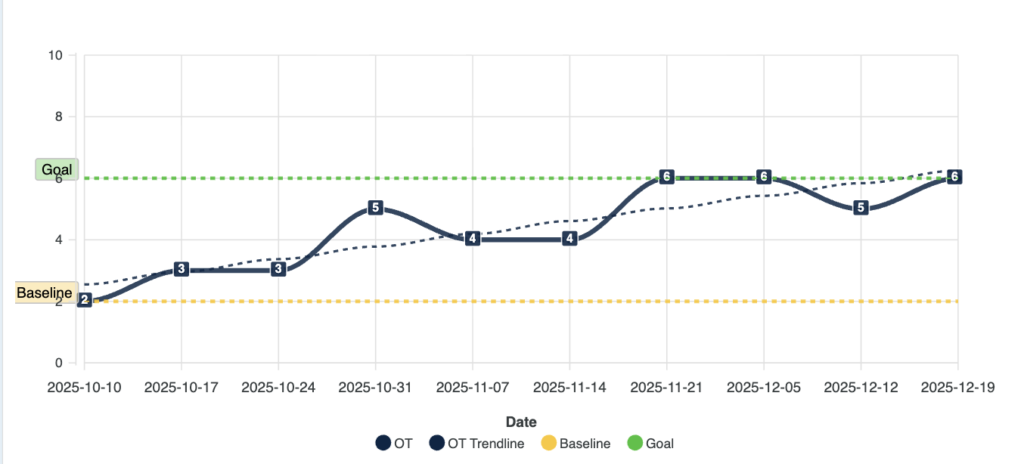
Baseline: 2 out of 6 handwriting criteria met
Those criteria might include:
- Correct letter formation
- Proper letter sizing
- Descenders placed below the line
- Correct baseline placement
- Appropriate upper/lowercase usage
- Completion of the writing prompt
If a student currently meets 2 of the 6 criteria, that becomes the baseline score.
This baseline matters because it determines:
- how much improvement is realistic
- whether the goal is appropriately ambitious
- how progress will be measured over time
Without a baseline, it becomes extremely difficult to determine whether a student is improving.
This issue appears frequently when schools review older IEPs that contain goals but no clear starting data.
The federal Individuals with Disabilities Education Act requires measurable goals and progress monitoring systems that allow teams to determine whether students are making progress toward those goals.
(See guidance from the U.S. Department of Education: Found Here!)
Clear baselines are a key part of that process.
What the Percentage or Score Means in Practice
Many occupational therapy goals use percentages like 80% accuracy.
But percentages only work when the scoring system is defined clearly.
For example, if the goal has six handwriting criteria, each session might be scored using a checklist.
A therapist or teacher may review the writing sample and record how many criteria were met.
If the student meets five of the six criteria, the score could be recorded as:
5 out of 6 criteria met (83% accuracy).
Instead of writing subjective comments like “handwriting improving,” teams record the score for each session.
Those scores become the data points used for progress monitoring.
Over time, the student’s performance might look like this:
2 → 3 → 3 → 5 → 4 → 6 → 6 → 5 → 6
Each number represents how many criteria were met during that observation.
When these scores are graphed across time, the team can clearly see whether the student is improving.
Graphing progress like this is one of the most reliable ways to track handwriting IEP goal progress monitoring. This approach reflects what strong programs do when they implement good IEP progress monitoring practices.
If you want to see more examples, our guides on how to write a baseline that actually works and easy ways to graph IEP progress without a spreadsheet explain how teams can structure measurable goals and track them consistently.
Why Handwriting Data Often Looks Messy at First
One thing teachers and therapists often notice is that handwriting progress does not improve in a perfectly straight line.
Some weeks the student may score a 5 or 6, while other weeks the score might drop back to 4.
This does not necessarily mean the student is regressing.
Handwriting and fine motor skills are influenced by many factors, including:
- fatigue
- writing speed expectations
- classroom distractions
- the length of the writing task
Because of this, individual scores may move up and down.
What matters more is the overall direction of the data.
If the trendline continues moving toward the goal, the student is likely making meaningful progress even when individual sessions vary.
This is why graphing progress is so valuable. It allows teams to see the pattern of improvement, not just the score from a single day.
When Teams Should Adjust an OT Goal
Progress monitoring is not just about documenting improvement.
It also helps teams know when instruction or supports may need to change.
For example, teams may consider adjusting instruction if:
- the data stays flat for several weeks
- scores consistently remain far below the goal
- the student reaches the goal much earlier than expected
When this happens, the IEP team may consider adjustments such as:
- modifying writing prompts
- adding structured handwriting practice
- increasing guided writing opportunities
- adjusting occupational therapy supports
Because the progress data is visible across time, these decisions become easier to explain and document during IEP meetings.
Instead of saying “we felt the student needed more support,” the team can point directly to the progress monitoring data.
Why This Matters for School Leaders
Occupational therapy services are often delivered by related service providers who work across multiple classrooms or buildings.
Because of that, documentation practices can vary widely.
From a district perspective, inconsistent progress monitoring creates several risks.
1. Progress reports become subjective
Without measurable data, reports often rely on narrative descriptions rather than evidence.
2. Teams cannot identify stalled progress early
Graphs and consistent monitoring allow schools to recognize problems months before the annual IEP review.
3. Decisions about services become harder to defend
If services are increased, reduced, or changed, documentation should clearly explain why.
Clear progress monitoring protects:
- the student
- the therapist
- the teacher
- and the school district
When administrators review special education documentation, one of the first questions they ask is simple:
What does the data show?
When progress monitoring is done well, the answer is immediately visible.
A Practical Way Teams Can Track OT Goal Progress
In practice, the most reliable system is simple.
- Define observable criteria clearly
- Score each session using the same checklist
- Record the score as a number or percentage
- Graph the results across time
This approach works whether the skill involves:
- handwriting
- cutting
- keyboarding
- organization
- task completion
What matters most is consistency.
When the measurement system stays the same, the data becomes meaningful.
And when the data becomes meaningful, teams can make better decisions for students.
A Quiet Reality in Special Education
Most educators genuinely want to monitor progress well.
The challenge is that busy classrooms and therapy schedules leave little time for complicated systems.
But the core idea is simple.
Good progress monitoring is not about collecting more data.
It is about collecting the right data consistently.
When teams do that, the story of the student becomes visible long before the annual IEP meeting.
And that is when the best decisions can actually happen.
A Note About Consistency in Occupational Therapy Data
One of the most important parts of monitoring occupational therapy IEP goals is consistency in how the data is collected.
If one therapist scores handwriting using six criteria and another therapist uses a different checklist, the results cannot be compared over time. This can make progress appear inconsistent even when the student is improving.
Schools that build simple, repeatable progress monitoring systems often see stronger collaboration between teachers, occupational therapists, and administrators.
When everyone understands how the data is collected, the information becomes easier to trust and easier to explain during IEP meetings.
Consistent data collection also allows teams to identify when interventions are working and when adjustments may be needed.
In many ways, the strength of a goal is not just the wording in the IEP, but the clarity of the data that follows it.
Frequently Asked Questions
What should be included in an occupational therapy IEP goal?
An occupational therapy IEP goal should clearly describe the skill being measured, the conditions of the task, the method of measurement, and the expected level of performance. It should also include a baseline so the team can measure improvement across time.
How often should OT IEP progress be monitored?
Most schools monitor occupational therapy goals weekly or during therapy sessions. The key is consistent measurement using the same scoring criteria so that progress data can be compared across multiple observations.
Why do occupational therapy IEP goals often use percentages?
Percentages allow teams to measure accuracy across several criteria, such as letter formation, sizing, and placement. When the scoring system is clearly defined, percentages provide a simple way to track progress toward the goal.