In many schools, IEP progress monitoring is treated as a task:
- Collect data
- Record a percentage
- Report progress at set intervals
This approach feels organized. Teachers are working hard, and data is being collected.
But this is not the same as a system.
When progress monitoring depends on individual routines, it creates variation across classrooms. One teacher may collect data weekly. Another may collect it inconsistently. One may define accuracy one way, while another defines it differently.
This is why, even in schools that are “doing” IEP progress monitoring, the overall system can still be weak.
As explained in What g What Does Good IEP Progress Monitoring Look Like? (With Examples)d IEP progress monitoring looks like, consistency across teams is one of the strongest indicators of a functioning system.
Why This Approach Breaks (Quietly)
The issue is not obvious at first.
Students receive services. Data is recorded. Reports are sent home.
But over time, small inconsistencies create larger problems:
- Data cannot be compared across classrooms
- Progress is difficult to interpret
- Patterns are missed
- Documentation becomes hard to defend
This is what we see in many of the situations described in 5 fatal IEP data mistakes that force compensatory ed. The problem is not that data is missing. It is that the data does not clearly show progress.
This type of breakdown is quiet. It does not show up until:
- A parent asks for clarification
- A supervisor reviews the data
- An audit or complaint occurs
At that point, teams are asked to explain something the system was not built to clearly show.
What the Baseline Is Supposed to Do
Every IEP goal starts with a baseline. But in many cases, the baseline is treated as a formality instead of a foundation.
A strong baseline should:
- Clearly define the student’s starting point
- Match the way data will be collected
- Connect directly to the goal
Without this connection, progress becomes unclear.
For example:
If a baseline says “Student answers comprehension questions with 50% accuracy,” but the way data is collected changes over time, then growth cannot be measured consistently.
This is why baseline clarity matters so much. As outlined in How to write a baseline that actually works, unclear baselines lead directly to unclear progress.
What the Data Actually Needs to Show
This is where many teams struggle.
A percentage alone does not show progress.
For example:
- Student A: 80%, 82%, 79%, 81%
- Student B: 50%, 60%, 70%, 75%
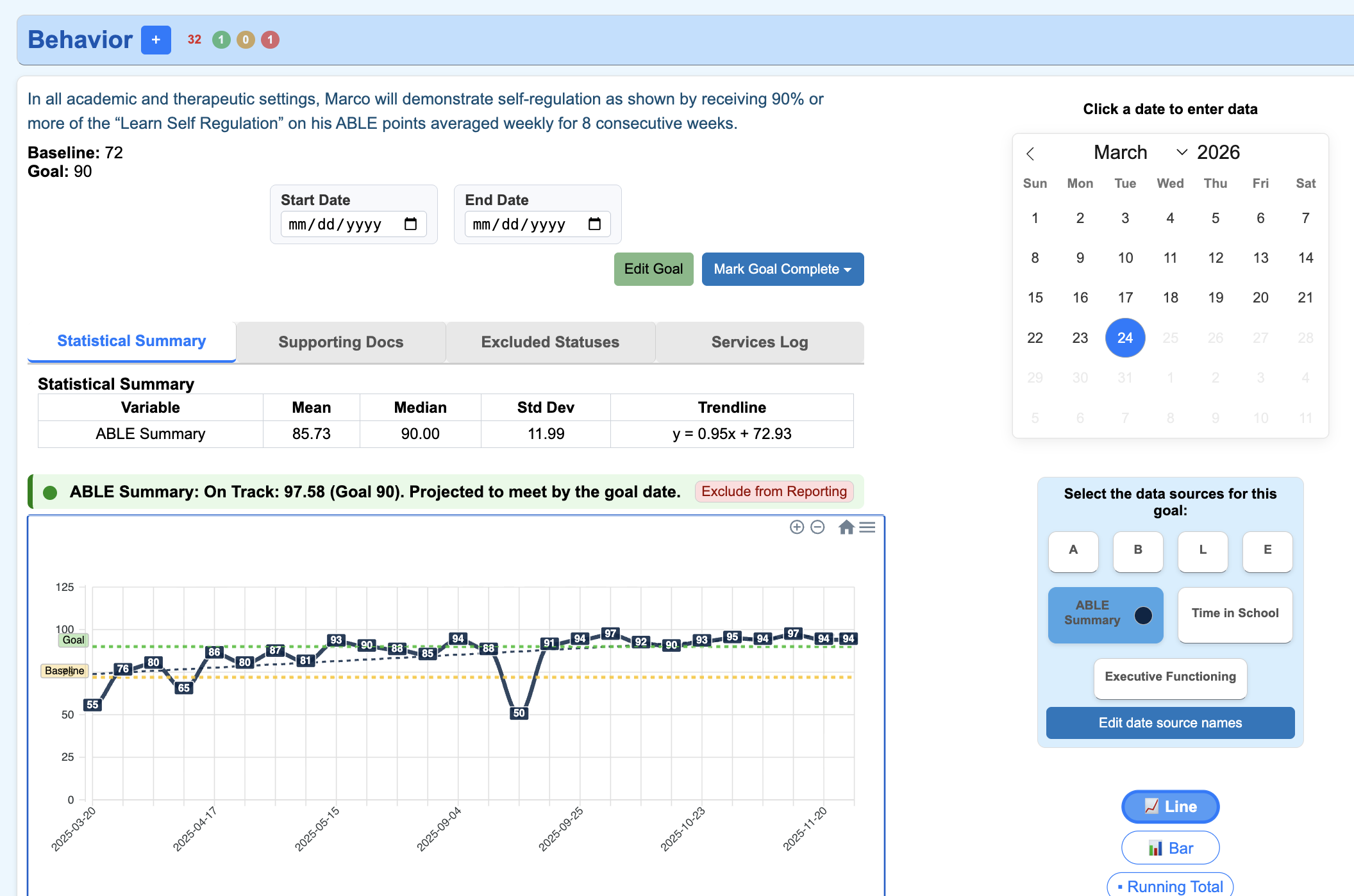
If you only look at the most recent score, Student A appears stronger. But when you look at the trend, Student B is making meaningful progress.
IEP progress monitoring should answer three questions:
- Is the student improving over time?
- Is the progress consistent?
- Is the student on track to meet the goal?
Without looking at trends, data points lose meaning.
This is why many teams struggle, even when they are collecting data regularly. The issue is not collection. It is interpretation.
How IEP Progress Monitoring Should Be Done
A strong IEP progress monitoring system is not based on individual routines. It is structured.
That means:
- Data is collected at defined intervals
- Data is collected the same way each time
- Progress can be reviewed at any point
This is aligned with federal expectations. According to the U.S. Department of Education, schools must measure and report progress toward IEP goals in a way that allows teams to determine whether students are making appropriate progress.
https://sites.ed.gov/idea/
Consistency is what allows teams to:
- Identify trends early
- Adjust instruction in real time
- Clearly explain progress to families and administrators
Without that consistency, progress monitoring becomes a record-keeping task instead of a decision-making tool.
When Teams Should Adjust Instruction
IEP progress monitoring is only useful if it leads to action.
Teams should consider adjusting instruction when:
- Progress is flat across multiple data points
- Progress is inconsistent without explanation
- The student is not on track to meet the goal
The problem in many schools is timing.
Without a clear system, these patterns are often missed until the IEP meeting. By then, valuable time has been lost.
A structured system makes these issues visible earlier, allowing teams to respond before the gap widens.
Why This Matters for School Leaders
For school leaders, this is not just an instructional issue. It is a risk issue.
When IEP progress monitoring is inconsistent or unclear, schools face:
- Findings during audits
- Parent complaints
- Requests for compensatory education
- Due process cases
The issue is not whether data exists. It is whether the data clearly shows that:
- Progress was monitored consistently
- Instruction was adjusted when needed
- Decisions were based on evidence
This is where defensibility comes in.
A clear system provides:
- Documentation that can be reviewed at any time
- Consistency across classrooms and programs
- Confidence during audits or disputes
Without that structure, even well-intentioned teams can struggle to demonstrate compliance.
Practical Implementation for Schools
Improving IEP progress monitoring does not mean adding more work. It means organizing the work that is already happening.
A practical approach includes:
- Setting clear expectations for how often data is collected
- Defining exactly how data should be measured
- Using a centralized system to store and review progress
- Training staff to interpret trends, not just record scores
Many schools are already collecting the right data. The difference is whether that data is usable.
When systems are aligned, teams spend less time managing information and more time making decisions.
Closing Reflection
Most schools are not failing to collect IEP data.
They are working hard. They are documenting. They are reporting.
But without structure, that effort does not always translate into clear, defensible progress monitoring.
The difference between “doing” IEP progress monitoring and doing it well comes down to one thing: whether the system makes student progress easy to see, understand, and explain.
That clarity is what supports teachers. It is what informs instruction. And it is what protects schools when questions arise.
Frequently Asked Questions
What is IEP progress monitoring?
IEP progress monitoring is the process of collecting and analyzing data to determine whether a student is making progress toward their IEP goals. It should be consistent, structured, and tied directly to the baseline and goal.
Why isn’t collecting data enough?
Collecting data alone does not show progress. Teams must look at trends over time, consistency, and whether the student is on track to meet their goal. Without this, data can be misleading.
How often should IEP progress be monitored?
IEP progress monitoring should happen at regular, defined intervals based on the goal. Consistency matters more than frequency, as it allows teams to accurately track and respond to progress.