
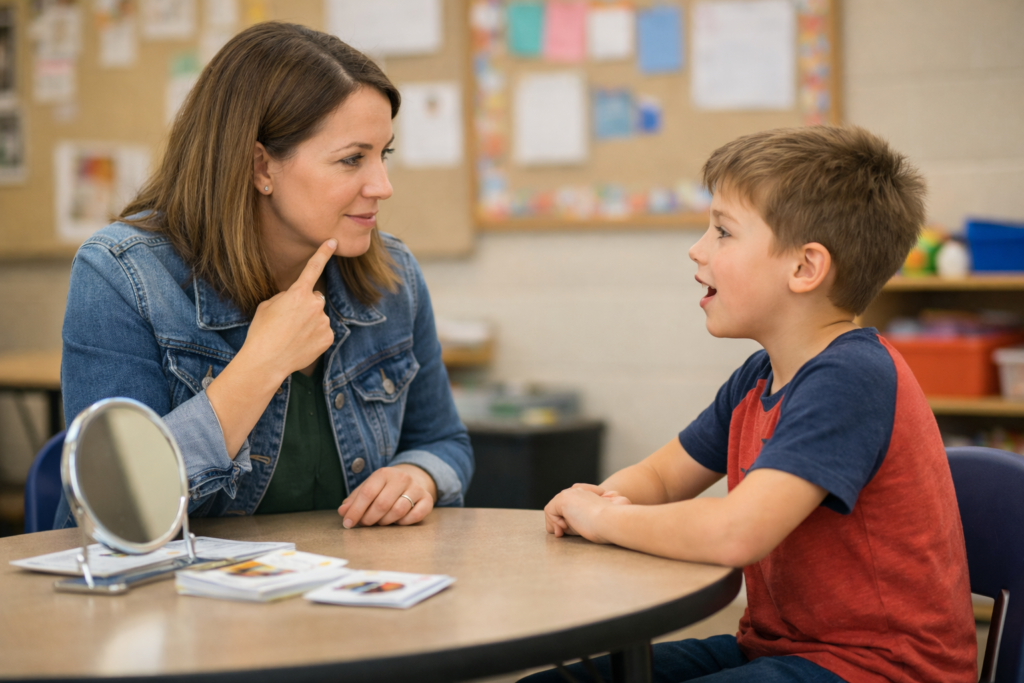
When we write a speech goal about “intelligibility,” it sounds simple on paper. Increase overall intelligibility to 80%. Use clear speech strategies. Three consecutive sessions.
However, in real classrooms and therapy rooms, intelligibility is not simple.
It affects peer relationships, classroom participation, and confidence. When a student is asked to repeat themselves over and over, that impacts more than just speech. It impacts how they feel about speaking at all.
Let’s break this goal down in practical terms.
This speech intelligibility IEP goal is designed to improve clarity during real conversations, not just isolated practice drills.
Understanding the Skill: What Is Intelligibility?
Intelligibility means how well a listener can understand a student’s speech.
In Marco’s case, the goal is:
During speech and language sessions, Marco will increase overall intelligibility by using clear speech strategies (slowed rate, exaggerated articulation, appropriate pausing) during conversation-level tasks, achieving 80% intelligibility across 3 consecutive data collection sessions.
This goal is focused on conversation-level tasks, not just word drills. That matters. Conversation requires carryover, not just practice.
The strategies listed are clear and measurable:
- Slowed rate
- Exaggerated articulation
- Appropriate pausing
These are observable behaviors. That makes the goal defensible and measurable.
The Baseline Tells the Real Story
Baseline (11/2025):
Marco is intelligible about 60% of the time in structured settings with context. Without context, intelligibility decreases. He is often asked to repeat up to 6 times in a 30-minute session.
That baseline matters.
First, 60% intelligibility means nearly half of what he says may not be clearly understood. Second, the fact that intelligibility drops without context tells us he may rely heavily on shared knowledge or visual cues.
Most importantly, being asked to repeat up to six times in a single session signals a real communication barrier.
This is why writing a clear baseline is critical. If you want to see how strong baselines protect teams, see To Write a Baseline That Actually Works
What Does 80% Actually Look Like?
Moving from 60% to 80% is not a small jump.
It means:
- Fewer repetition requests
- More independent clarity
- Better participation in group discussion
- Reduced frustration
However, 80% does not mean perfect speech. It means that in most conversational exchanges, the listener understands him the first time.
Across three consecutive sessions ensures this is not a fluke. It shows consistency.
A well-written speech intelligibility IEP goal makes it clear what that percentage means in everyday communication.
Consistency is what makes data meaningful. If you want a deeper look at what strong monitoring looks like in practice, see What Does Good IEP Progress Monitoring Look Like? (With Examples)
How Should This Be Progress Monitored?
Because the goal targets conversation-level speech, progress monitoring should also occur during authentic conversation.
For example:
- 10–15 minute structured conversation tasks
- Tally intelligible vs unintelligible utterances
- Note strategy use (rate, articulation, pausing)
- Record repetition prompts
In addition, data should be collected consistently. According to U.S. Department of Education guidance on IEP implementation, schools must ensure that services and progress monitoring align with the written IEP.
Clear data protects both students and staff.
Why This Goal Matters Beyond Speech
Improved intelligibility supports:
- Peer interaction
- Classroom participation
- Self-advocacy
- Academic performance
When a student does not need to repeat themselves six times, they are more likely to contribute. As a result, confidence improves alongside clarity.
Speech goals are not just about articulation. They are about access.
That is why a strong speech intelligibility IEP goal focuses on functional communication, not just sound production.
Why This Matters for School Leaders
For directors and administrators, a speech intelligibility IEP goal is not just about instruction. It is about documentation and defensibility.
If a goal states 80% intelligibility but does not define how that percentage is measured, teams may interpret progress differently. That inconsistency can create confusion during IEP meetings and, in more serious cases, during compliance reviews.
Clear baselines, measurable strategies, and consistent data collection reduce risk. They ensure that when progress is reported, everyone understands exactly what was measured and how growth was determined.
Strong goals protect students first. However, they also protect staff and districts by making expectations transparent.
Final Thought
An 80% intelligibility goal is not about perfection. It is about reducing communication barriers in real, daily interactions.
If you are writing or reviewing a speech goal like this, ask yourself:
- Is the baseline specific enough?
- Are the strategies observable?
- Is progress monitoring practical?
- Would another adult understand exactly how to measure it?
Small clarity improvements can make a large difference for a student.
Frequently Asked Questions
What is a speech intelligibility IEP goal?
A speech intelligibility IEP goal measures how clearly a student can be understood during conversation. It focuses on functional communication, not just sound production in isolation.
How is speech intelligibility measured in schools?
Intelligibility is typically measured by calculating the percentage of understood utterances during structured or natural conversation tasks. Data should reflect real communication situations.
Is 80% intelligibility considered mastery?
In many school-based settings, 80% indicates consistent clarity during conversation. It does not require perfect articulation, but it shows reliable functional communication.
One thought on “What Does an 80% Speech Intelligibility Goal Really Mean?”