Most special education teachers care deeply about progress monitoring. They track goals. They collect data. They keep records.
But there is a problem almost no one talks about:
The data rarely survives the transitions students go through.
A new teacher.
A new program.
A schedule change.
A different school.
And suddenly the team is piecing together progress based on whatever documents happen to still exist.
Not because the staff did not care.
But because the system was not built to preserve continuity.
What “lost” data really looks like
It does not always mean paperwork vanishes.
More often, it looks like this:
- Progress notes saved on a local computer
- Data spread across multiple spreadsheets
- Graphs created at the end of a marking period
- Baseline information rewritten instead of reused
- A teacher storing everything in their own system
Everything works until the teacher leaves or the student moves.
Strong IEP progress monitoring data should stay consistent, even when students change teachers or programs
Then the new team starts over.
Again.
The cost is not just time, it is instruction
When data does not follow the student, schools lose:
- Trend history
- Instructional context
- What worked
- What did not
- How the goal was measured
So instead of refining instruction, teams rebuild the story from scratch.
That means delayed responses, repeated strategies, and missed opportunities to adjust earlier.
The student journey should not reset every year
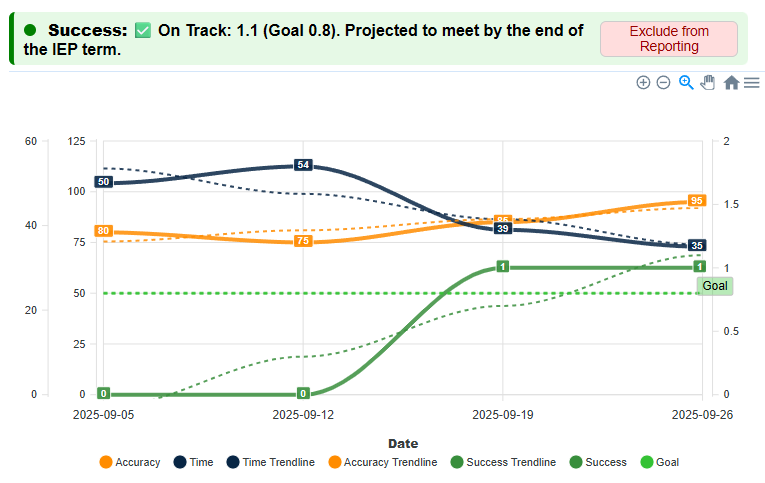
If a student receives services for eight to ten years, their progress story should be visible the whole way through.
Teachers should be able to see:
- Where the student started
- How they responded to instruction
- When changes were made
- Which strategies helped
- Whether performance was stable or fragile
That should not live inside one person’s memory.
It should live inside the system.
Compliance is not the real goal, continuity is
You can technically be compliant while still losing valuable learning history.
But strong progress monitoring is not just about having data.
It is about protecting meaning.
When measurement methods change, when graphs are rebuilt, and when baselines are re-entered, the data becomes less comparable.
Comparable data is what lets teams make confident instructional decisions.
What students deserve
Students deserve systems where:
- Data follows them
- Baselines do not need to be rewritten
- Measurement stays consistent
- Progress is visible over time
- New teams inherit clarity, not mystery
That is what reduces stress for teachers, raises trust for families, and improves support for students.
Because everyone can finally see the same picture.
Why we built IEP Report this way
We are classroom teachers.
We built IEP Report because we were tired of watching important progress history quietly disappear every time a student changed hands.
Our goal was not more paperwork. It was continuity.
So teams can talk about instruction instead of hunting for files.
Final thought
Progress monitoring is not just about documenting the past.
It is about protecting the student’s story so every educator who supports them can move that story forward.
You can learn more about federal special education guidance here.
2 thoughts on “The Silent Problem in Special Education: Data That Does Not Travel With the Student”