School leaders are responsible for outcomes, but they rarely see the full picture.
In special education, that gap shows up in one place more than anywhere else. Progress monitoring.
On paper, everything looks fine. Goals are written. Services are delivered. Reports go home.
But when someone asks a simple question like, “Is this student actually making progress?” the answer is often unclear.
Not because teachers are not doing the work. Because the system makes it hard to see.
That is the real issue behind most compliance concerns, parent frustrations, and due process cases.
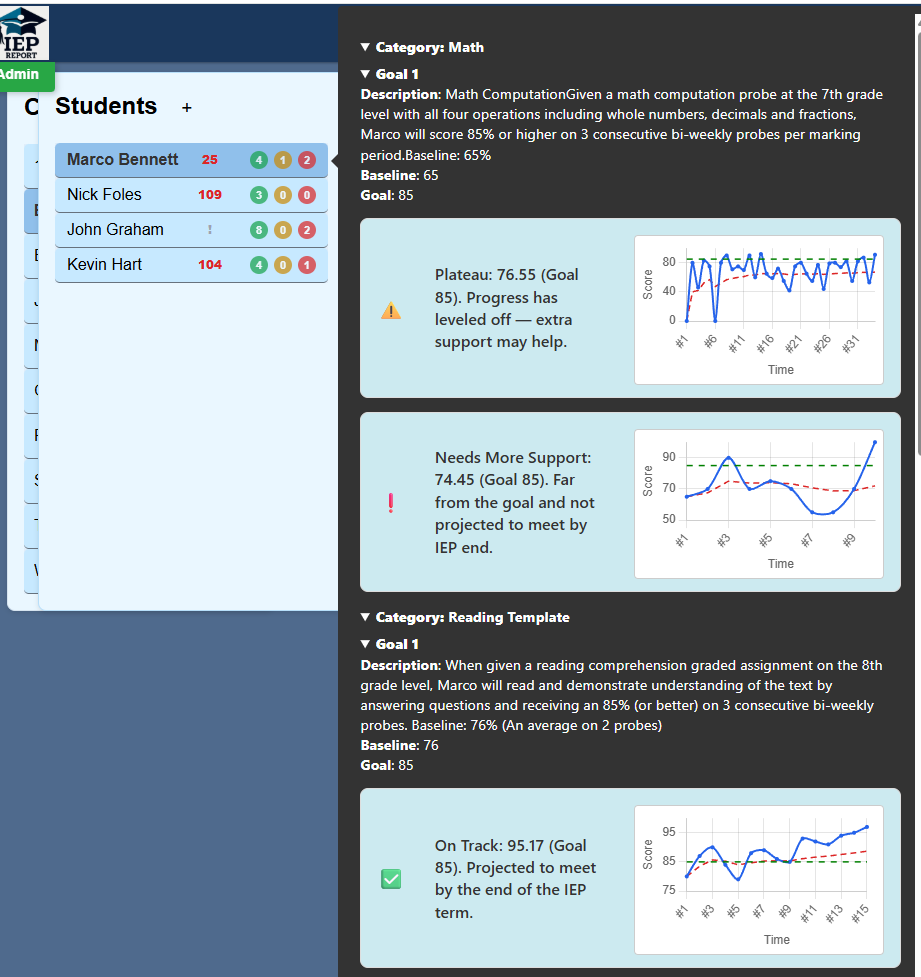
Suggested image description:
A clean dashboard showing a student progress graph with baseline and goal line clearly marked.
Suggested alt text:
IEP progress monitoring graph showing student performance over time with baseline and goal
The Real Problem With IEP Progress Monitoring
Most schools are doing IEP progress monitoring.
The problem is how it is being captured.
Data is often spread across notebooks, spreadsheets, printed probes, or systems that do not connect. Each teacher may be collecting data in a slightly different way.
That creates inconsistency.
When data is inconsistent, it becomes difficult to answer basic questions:
- Is the student improving?
- Are interventions working?
- Is the rate of progress enough to meet the goal?
This is where strong IEP data tracking starts to break down.
Even when data exists, it is not always usable.
What a Baseline Actually Tells You
A baseline is supposed to answer one question. Where is the student starting?
But in practice, baselines are often written without enough context.
For example:
“Student is currently reading 45 words per minute.”
That number only matters if it is tied to:
- how it was measured
- how often data will be collected
- what growth is expected
Without that, the baseline becomes a number that cannot guide instruction.
If you want a deeper breakdown, this is why many teams struggle with how to write a baseline that actually works.
A strong baseline allows teams to:
- measure change over time
- compare performance to the goal
- defend decisions if questioned
Without it, progress monitoring becomes guesswork.
What the Data Actually Means in Practice
Let’s take a simple example.
A student has a goal to increase reading accuracy from 60% to 80%.
After six weeks, the student is at 65%.
On paper, that looks like progress.
But in practice, it raises questions:
- Is that growth fast enough?
- Will the student reach the goal by the deadline?
- Does instruction need to change?
This is where many schools get stuck.
The data is there, but it is not interpreted.
Strong IEP progress monitoring is not just about collecting numbers. It is about understanding the rate of change.
This is also where visual tools matter. Teams that use clear graphs tend to make better decisions, which is why many look for easy ways to graph IEP progress.
When trends are visible, decisions become easier.
How Progress Should Actually Be Monitored
Effective IEP progress monitoring follows a few consistent patterns:
- Data is collected regularly
- The same method is used each time
- Results are recorded in a consistent format
- Trends are reviewed, not just individual scores
This sounds simple, but it is difficult to maintain without structure.
In many schools, monitoring becomes reactive. Data is reviewed right before progress reports or meetings instead of continuously.
That leads to missed opportunities to adjust instruction earlier.
According to guidance from the U.S. Department of Education, schools are expected to ensure that IEP goals are measurable and that progress is monitored in a way that informs instruction and reporting (https://sites.ed.gov/idea/).
That expectation requires systems, not just effort.
When Teams Should Adjust Instruction
One of the biggest risks in special education is waiting too long.
If a student’s data shows:
- little to no growth
- inconsistent performance
- a trend below the expected rate
instruction should be adjusted.
But without clear IEP data tracking, those patterns are easy to miss.
Teams often rely on professional judgment, which is important, but should be supported by data.
The goal is not to react at the end of a marking period. It is to respond in real time.
This is what separates compliance from effective practice.
Why This Matters for School Leaders
For administrators, this is not just about instruction.
It is about risk.
When progress monitoring is unclear, several things happen:
- documentation becomes inconsistent
- reports are harder to defend
- parent trust decreases
- due process risk increases
Clear IEP progress monitoring creates:
- defensible documentation
- consistent reporting across classrooms
- visibility into student progress
- confidence in decision-making
This is why many leaders are starting to ask a different question.
Not “Are we collecting data?” but “Can we actually use it?”
That shift is where systems begin to matter.
Practical Implementation for Schools
Improving IEP progress monitoring does not require a complete overhaul.
Most schools can start with a few steps:
- standardize how data is collected
- define clear expectations for frequency
- ensure baselines are measurable and usable
- review trends regularly at team meetings
The next step is making the data visible.
When administrators can quickly see:
- which students are on track
- which are plateauing
- which need intervention
they can support teams more effectively.
This is also where tools begin to play a role.
Not to replace teachers, but to organize and surface the work they are already doing.
Closing Reflection
Most schools are not failing at IEP progress monitoring.
They are just not seeing it clearly.
The data exists. The effort is there.
What is missing is visibility.
When progress monitoring becomes clear, everything else improves.
Instruction gets stronger. Conversations get easier. Decisions become more confident.
And most importantly, students get the support they actually need.
Frequently Asked Questions
What is IEP progress monitoring in simple terms?
IEP progress monitoring is the process of collecting and reviewing data to see if a student is making progress toward their goals. It helps teams decide if instruction is working or needs to change.
How often should IEP data be collected?
Data should be collected regularly and consistently, often weekly or biweekly depending on the goal. The key is using the same method each time so trends can be accurately measured.
Why is IEP data tracking important for administrators?
IEP data tracking gives administrators visibility into student progress across classrooms. It supports compliance, improves decision-making, and reduces risk during audits or due process situations.