By May, most schools are moving fast. For students with IEPs, this is also the moment when progress data either tells a clear story or exposes gaps that were easy to miss before summer. End of year IEP progress monitoring is not just paperwork. It is a leadership review of whether goals were measured, progress was reported clearly, and teams have enough documentation to support decisions for next year. It also helps leaders see support needs before staff leave. When this review is rushed, teachers feel pressure, families receive unclear information, and districts may struggle to explain what happened instructionally.
What End of Year IEP Progress Monitoring Is Really Checking
The end-of-year review is a check for a clear progress story.
School leaders should look at the goal, baseline, measurement method, data points, progress statement, and any instructional changes. The basic question is simple: can the team explain what was measured, what changed for the student, and what should happen next?
What the Baseline Tells Leaders First
The baseline is the starting point. At year end, it helps leaders judge whether the student made meaningful progress from where they began.
A reading fluency goal might begin with 42 words read correctly per minute. A behavior goal might begin with 8 interruptions during a 30-minute lesson. Those numbers make growth easier to explain.
If the baseline was vague, the review becomes harder. That is why strong teams keep returning to how to write a baseline that actually works. Clear baselines protect the team later because they anchor the whole progress story.
What the Percentage or Metric Means in Practice
A number by itself is not enough. School leaders need to know what the number means in the real classroom.
For example, a student may move from 50 percent accuracy to 70 percent accuracy on a math goal. That shows growth. But if the annual goal was 90 percent accuracy across three trials, the team still needs to ask whether the student is on track and whether instruction should change.
This is where an IEP progress report review should go beyond "met" or "not met." Leaders should ask whether the metric is understandable, whether it matches the goal, and whether the data supports the conclusion.
Federal IDEA regulations require IEPs to describe how progress toward annual goals will be measured and when reports will be provided. The official IDEA regulation on IEP content is a helpful source for this review.
How Progress Should Be Monitored
Progress should be monitored in a consistent way that matches the goal. If the goal says weekly reading fluency probes, the data should show weekly probes. If the goal uses percentage accuracy, frequency, duration, rubric scores, or trials, the data should match that method.
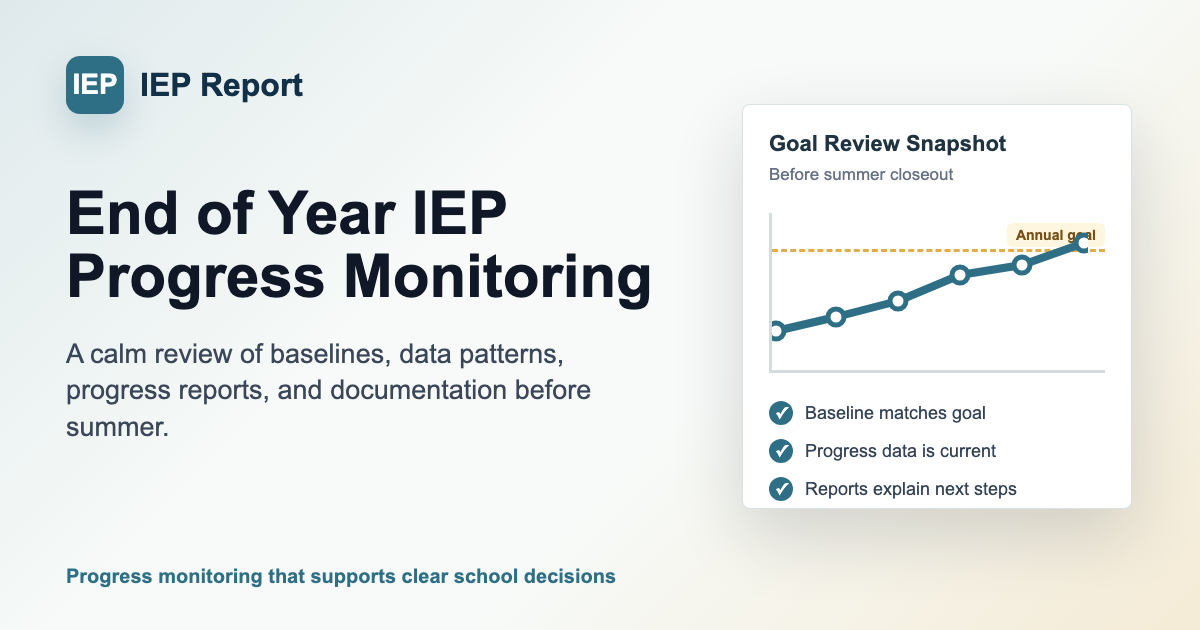
End of year IEP progress monitoring is most useful when leaders can see the full pattern, not just the final score. A student may finish near the target but still have long data gaps. Another may miss the goal but show steady growth after instruction changed.
If frequency is unclear, teams can review how often IEP progress should be monitored and decide whether the local routine is strong enough.
When Teams Should Adjust Instruction
Progress monitoring is only useful if teams respond to it. Teams should consider adjusting instruction when data shows little growth, performance declines, the student is not on track, or the measurement method does not match the skill being taught.
At the end of the year, leaders should look for evidence that concerns were noticed before the final report. If a student had flat progress in February, was anything changed in March? If the team changed intervention, was that documented?
Why This Matters for School Leaders
For school leaders, end of year IEP progress monitoring touches compliance, documentation, defensibility, and district-level risk.
Compliance matters because progress reporting is part of the IEP process. Families should receive clear information about progress toward annual goals.
Documentation matters because memories fade. By September, staff and schedules may change, and the team may not remember why a decision was made.
Defensibility matters because questions often come later. If a parent, advocate, administrator, or reviewer asks what happened, the school should be able to show the data and the response.
District-level risk increases when every classroom has a different system. Leaders need visibility across buildings.
Practical Implementation for Schools
A practical review does not need to be complicated. Start with a small sample of goals across grade levels, service areas, and buildings. For each goal, check the baseline, current data, progress statement, method, and reporting schedule.
Then look for patterns:
- Are baselines measurable?
- Are progress reports backed by actual data?
- Are graphs or records current?
- Are instructional changes documented when progress is limited?
An IEP progress report review should end with next steps. That may include summer data cleanup, staff training, clearer baselines, a common monitoring schedule, or a better way to store progress data.
Closing Reflection
The end of the year is not only a finish line. It is a documentation checkpoint.
When progress data is clear, teams can explain what students learned, what still needs support, and what should happen next. Teachers feel less exposed, families receive clearer information, and leaders can decide with more confidence.
End of year review does not need to be about blame. Done well, it helps schools close the year honestly and start the next year with better information.
Frequently Asked Questions
What should school leaders review for end of year IEP progress monitoring?
School leaders should review the baseline, current data, progress statement, method, and reporting schedule for each goal. They should also check whether instruction changed when data showed limited progress.
Why is the baseline important at the end of the year?
The baseline gives the team a starting point for judging growth. Without a measurable baseline, it is harder to explain whether the student made meaningful progress toward the annual goal.
How can schools make IEP progress reports more defensible?
Schools can make reports more defensible by tying each progress statement to current data and using the same measurement method throughout the year. Clear records help teams explain decisions later.