In special education, problems rarely appear all at once. They build quietly. A graph is missing. A baseline is unclear. A teacher is collecting data, but the method does not match the goal. By the time the concern reaches an IEP meeting, audit, complaint, or due process review, the school may already be explaining months of weak documentation. IEP progress monitoring warning signs help leaders catch those issues earlier. They are not about blaming teachers. They are about seeing where the system is becoming unclear.
What Counts as an IEP Progress Monitoring Warning Sign
An early warning sign is any pattern that makes student progress harder to measure or defend.
Some are obvious. A student has no recent data. A progress graph is blank. A report says “progressing” but does not include measurable evidence. Others are quieter:
- Data is collected inconsistently.
- The measurement method changes.
- The baseline does not match the goal.
- Staff track the same skill differently.
- The graph is flat, but instruction has not changed.
Progress monitoring should tell an instructional story. If the story is hard to follow, leaders need to look closer. This connects to what good IEP progress monitoring looks like, where consistency and usable data are the foundation.
What the Baseline Tells Leaders First
A baseline is often the first place warning signs appear. A strong baseline tells the team where the student started, how performance was measured, and what tool or condition was used. A weak baseline leaves the team guessing.
For example, a baseline that says “student struggles with written expression” does not help the team monitor progress. It provides no score, date, task, rubric, or work sample.
When baselines are vague, every later data point becomes easier to question. Leaders should review baselines before graphs because the graph can only be as clear as the starting point. How to write a baseline that actually works is a useful place to begin.
What the Percentage or Metric Means in Practice
Percentages can create a false sense of clarity. A student who scores 75 percent may appear close to the goal. But leaders still need to know what was measured and whether the score is part of a trend.
Consider a student with a goal of 85 percent accuracy:
- Week 1: 70 percent
- Week 2: 72 percent
- Week 3: 71 percent
- Week 4: 70 percent
The student is near the goal, but the trend is flat.
Now consider another student:
- Week 1: 40 percent
- Week 2: 52 percent
- Week 3: 61 percent
- Week 4: 68 percent
That student is farther from the goal but showing growth.
Leaders should focus on trends, not single scores. A number without context can hide risk.
How Progress Should Be Monitored
Progress should be monitored according to the IEP, not convenience. IDEA requires IEPs to describe how progress toward annual goals will be measured and when periodic reports will be provided. Schools can review that requirement in 34 CFR 300.320(a)(3).
In practice, monitoring should include:
- A clear data collection schedule
- The same measurement method over time
- Data points tied directly to the goal
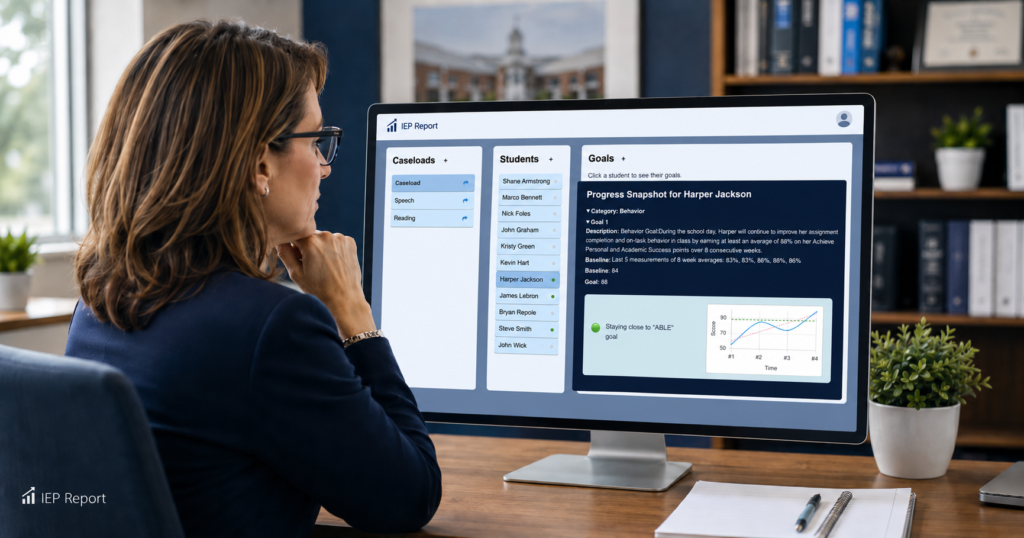
- A graph or trend record
- Notes when instruction or intervention changes
One warning sign is when data only appears right before reports are due. Another is when data is entered in batches with no clear collection dates.
When Teams Should Adjust Instruction
The purpose of progress monitoring is not just reporting. It is response. Teams should consider adjustment when a student has several data points with little growth, inconsistent performance, or a trend below the expected rate.
If a behavior goal shows no improvement for six weeks, the team should not wait until the annual review. Leaders should ask whether supports, data, or the plan need adjustment.
This is where special education compliance warning signs become instructional warning signs too.
Why This Matters for School Leaders
For school leaders, weak progress monitoring is not a small paperwork issue. It is a visibility issue. When data is weak, leaders may not know which students are making progress or which classrooms need support.
If a student is not making progress and the team does not see it early, the school loses time. If a teacher is collecting data but the system does not organize it clearly, the teacher’s work may not be visible.
These issues are described in 5 fatal IEP data mistakes that force compensatory ed.
Practical Implementation for Schools
Schools can start by reviewing a small sample of IEP goals across classrooms. A short monthly review of IEP progress monitoring warning signs can help leaders spot gaps before reporting deadlines. For each goal, leaders can ask:
- Is the baseline measurable?
- Does the data match the goal?
- Are data points recent?
- Is the trend clear?
- Has instruction changed when progress is flat?
This review should not feel like a compliance hunt. It should be a support tool that helps teachers tighten documentation and makes progress easier to explain.
Closing Reflection
Most IEP progress monitoring problems do not begin as major failures. They begin as small signs: a missing data point, a vague baseline, a graph that does not match the goal, or a flat trend no one has discussed.
The earlier leaders see those signs, the easier they are to fix. IEP progress monitoring warning signs give schools a practical way to protect students, support teachers, and strengthen documentation before the problem becomes harder to explain.
Frequently Asked Questions
What are IEP progress monitoring warning signs?
IEP progress monitoring warning signs are patterns that make student progress hard to measure or explain. Common examples include missing data, vague baselines, inconsistent measurement, and flat trends with no instructional adjustment.
Why do warning signs matter for compliance?
Warning signs matter because schools must be able to show how progress toward IEP goals is measured and reported. If the documentation is unclear, the school may struggle to defend decisions during reviews, complaints, or disputes.
How often should school leaders review IEP progress data?
School leaders should review IEP progress data regularly enough to catch problems before reporting periods or meetings. A monthly or biweekly review of high-need goals can help teams respond earlier.