When people hear the name IEP Report, they may think it is only a tool for creating progress reports. That makes sense, but it does more than that. The real purpose is to help schools understand what is happening with IEP goals during the school year.
In many schools, progress monitoring data lives in too many places. One teacher has a spreadsheet. Another has notes in a folder. A related service provider has session data somewhere else. By the time progress reports are due, teams may be trying to pull the story together after the fact.
In simple terms, IEP Report helps schools turn IEP goal data into clear progress information teachers, families, and leaders can actually use.
IEP Report helps bring that work into one clearer system. It helps teachers collect data, graph progress, add notes, and prepare reports that families and school teams can understand.
What IEP Report is built to do
IEP Report is built around a simple idea: progress monitoring should be easier to collect, easier to understand, and easier to explain.
It is not just a report generator. It is a progress monitoring tool that helps schools connect the pieces that are often separated. Those pieces include the IEP goal, the baseline, the data collected over time, the graph, the teacher’s notes, and the progress report.
That connection matters. A progress report should not be a guess. It should be based on actual data that shows whether the student is moving toward the goal.
For example, a teacher may be tracking a reading fluency goal, a behavior goal, a writing rubric, or a math accuracy goal. Each goal may use a different type of data. IEP Report helps organize that information so the team can see the pattern, not just the most recent score.
This is especially helpful because progress monitoring is not only about the final report. It is about what the data shows while there is still time to adjust instruction.
Why the baseline matters
Every strong progress monitoring system starts with the baseline. The baseline tells the team where the student started. Without it, the rest of the data is harder to understand.
If a student has a goal to answer comprehension questions with 80% accuracy, the team needs to know the starting point. Was the student answering questions with 30% accuracy? 50% accuracy? 70% accuracy with prompts?
Those details matter. A student moving from 30% to 55% may be making meaningful growth, even if the student has not met the annual goal yet. A student moving from 70% to 72% may need a different conversation.
IEP Report helps schools keep the baseline connected to the goal and the ongoing data. That makes the progress easier to explain and more useful for decision-making.
This is also why schools need clear baselines before they begin collecting data. A vague baseline leads to vague progress monitoring. A clear baseline gives the team a stronger starting point. For more on this, schools can review [How to Write a Baseline That Actually Works].
What the percentage or metric means in practice
One challenge with IEP goals is that different goals use different measures. A percentage, score, frequency count, duration measure, or rubric score can all be valid, but they do not mean the same thing.
For a math goal, 80% may mean the student solved 8 out of 10 problems correctly. For a speech goal, 80% may mean the student was understood in 8 out of 10 speaking opportunities. For a behavior goal, progress may be shown by reducing the number of incidents per week. For a writing goal, progress may be shown through a rubric score across several writing samples.
IEP Report helps make those measures visible over time. That matters because one data point rarely tells the full story.
For example, a student may score 60%, 65%, 70%, and 72% over several weeks. That trend tells a different story than a student who scores 70%, 68%, 65%, and 60%. Both students may be near the same range, but one is moving toward the goal and the other may be moving away from it.
This is where an IEP progress monitoring tool can help teachers and leaders see patterns more clearly.
How progress should be monitored
Progress should be monitored in a way that matches the IEP goal. If the goal is about reading fluency, the data should measure fluency. If the goal is about task completion, the data should measure task completion. If the goal is about self-regulation, the data should connect to the self-regulation skill being taught.
IDEA requires IEPs to describe how progress toward annual goals will be measured and when periodic reports will be provided to parents. That requirement is listed in the federal IDEA regulations under 34 CFR §300.320(a)(3). IDEA regulations on measuring and reporting progress
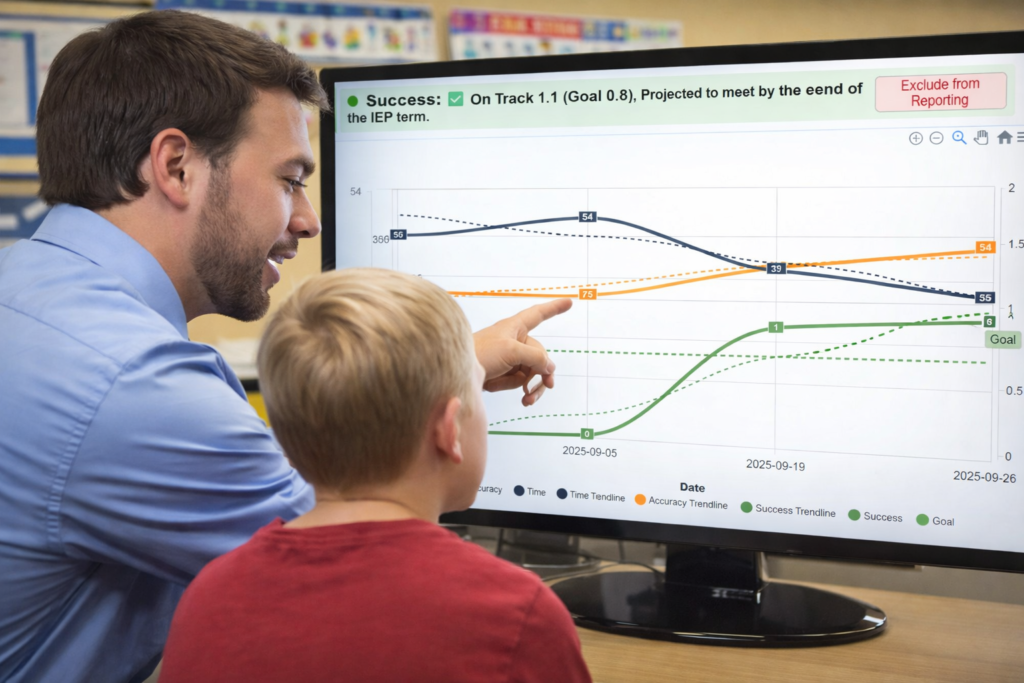
IEP Report supports this work by giving teachers a place to enter progress data throughout the year. Teachers can add scores, dates, notes, and related information. The system can then help turn that data into graphs and reports.
This helps avoid the common problem of progress monitoring being done only when reports are due. When data is collected consistently, teams can use it during the year, not just at the end of the marking period.
For a deeper look at this idea, see What Good IEP Progress Monitoring Looks Like.
When teams should adjust instruction
Progress monitoring should lead to action. If data shows a student is not making enough progress, the team should not wait until the annual IEP meeting to talk about it.
A few low scores do not always mean instruction is failing. Students have difficult days. Absences, schedule changes, behavior needs, health issues, and testing conditions can all affect performance.
But when the data shows a repeated flat trend, a drop in performance, or little movement toward the goal, the team should review the plan. That may mean changing the intervention, adjusting the level of support, increasing practice opportunities, reviewing accommodations, or looking more closely at the goal itself.
IEP Report helps make those conversations easier because the data is visible. Instead of relying only on memory, staff can look at the graph, the notes, and the pattern over time.
That is the practical value of progress monitoring. It gives the team a chance to respond before the student falls further behind.
Why This Matters for School Leaders
For school leaders, IEP Report is not only about helping teachers complete progress reports. It is about visibility, consistency, and defensibility.
Special education leaders need to know whether progress monitoring is happening across classrooms, programs, and buildings. They also need to know whether the data is clear enough to support decisions.
When progress data is scattered, leaders may not see problems until a parent complaint, due process concern, or compensatory education discussion begins. At that point, the district may be trying to reconstruct what happened months earlier.
Clear documentation helps reduce that risk. It shows what was measured, when it was measured, what the data showed, and how the team responded.
This does not mean every student will meet every goal. It means the school has a clearer record of instruction, monitoring, communication, and decision-making.
That matters for compliance. It matters for documentation. It matters for district-level risk. Most importantly, it matters for students, because leaders can better support teachers when they can see where support is needed.
Practical implementation for schools
A progress monitoring system should make the work easier, not harder. Teachers already have enough to manage. If a system adds too many steps, staff may avoid using it or only use it when reports are due.
IEP Report is designed to support the work teachers already need to do. It helps organize students, goals, data, graphs, notes, and reports in a clearer way.
IEP Report gives schools one place to organize that work instead of spreading progress data across paper notes, spreadsheets, and separate files.
A practical school system should help staff:
Collect data tied to IEP goals.
See progress over time.
Add notes when context matters.
Use graphs to explain trends.
Prepare progress reports for families.
Give leaders better visibility into goal progress.
This kind of system can also support parent communication. Families do not just need a statement that says a child is making progress or not making progress. They need information they can understand.
A clear graph, a short note, and goal-based data can make the conversation more meaningful. It helps families see what is improving, what still needs support, and what the team is doing next.
For schools that are still using spreadsheets, paper notes, or disconnected systems, this is where Easy Ways to Graph IEP Progress Without a Spreadsheet may be helpful.
Closing reflection
IEP Report exists because progress monitoring should be clearer for everyone involved.
Teachers need a practical way to collect and explain data. Families need progress information they can understand. School leaders need better visibility into what is happening across special education programs.
The name IEP Report may sound like it is only about the final report. But the real value is in the process before the report is written.
It helps schools track goals, see trends, document progress, and respond when students need something different.
Good progress monitoring does not need to be complicated. It needs to be consistent, clear, and useful.
Frequently Asked Questions
What is IEP Report?
IEP Report is a tool that helps schools track IEP goal progress, graph student data, add teacher notes, and create clearer progress reports. It is designed to support progress monitoring during the school year, not just at reporting time.
Is IEP Report only for writing progress reports?
No. IEP Report helps with the full progress monitoring process. It connects goals, baselines, data, graphs, notes, and reports so teams can better understand student progress.
How does IEP Report help school leaders?
IEP Report helps school leaders see whether progress monitoring is happening across students, goals, and programs. This supports compliance, documentation, parent communication, and better district-level decision-making.